
How do I install Amazing Relay?
For most users, open the Amazing Relay download page and install it from the Chrome Web Store. Chrome then manages normal extension updates automatically.
If your company uses the manually installed DEV version, use the files and instructions at Manual installation and setup. Run only one Amazing Relay version at a time. If both the Store and DEV versions are enabled, Amazing Relay blocks the duplicate runtime instead of loading twice.
How do I run my first Monitoring search?
Amazing Relay works inside the Amazon Relay Load Board. Start with a real Amazon saved search that already returns the general type of loads you want.
- Open that saved search.
- Open the Amazing Relay filters and set only the requirements you need. An empty field does not apply that filter.
- Select Monitoring. It finds matching loads and leaves the booking decision to you.
- Choose a refresh speed and any alerts you want.
- Press START.
During START, Amazing Relay refreshes the current saved search and checks the returned loads against your filters.
What does Clear filters reset?
Clear filters removes the load-filter values. It does not change Monitoring/Autobook, Refresh speed, Alarm, Price alerts, or Demand Chat alerts. It keeps the selected Pickup mode, resets the pickup duration to 60 minutes, and clears the saved pickup dates.
What should I do if multiple Amazing Relay extensions are detected?
Open chrome://extensions and leave only the Amazing Relay version you intend to use enabled. Disable or remove every other Amazing Relay copy, then reload the Amazon Relay Load Board.
Do not run Store, DEV, or DEV-DEV copies together. Chrome may show more than one Amazing Relay entry when a test build was left enabled after installation.
What is the difference between Monitoring and Autobook?
Monitoring stops on a matching load, displays it, and alerts you. You review the result and decide whether to book.
Autobook automatically attempts to book the matching load with the highest total payout. If several loads match in the same response, total payout—not their position in the list—determines which one is attempted first.
Use Monitoring until you are comfortable that the Amazon saved search and every Amazing Relay filter describe loads you are willing to accept.
What happens when an Autobook attempt is missed or fails?
If the selected load is no longer available, Amazing Relay marks it Missed and continues searching. A different booking error appears as Booking failed so you can review it. After a successful booking, the search stops and the alarm sounds.
Autobook uses the repeating alarm because it can act without another click. Use STOP ALARM or start a new search to stop a currently playing alarm.
How is Fastbook different from Autobook?
Fastbook is a manual one-click booking action on a visible load card. Autobook attempts to book automatically while a search is running. Enable Fastbook only if you are comfortable booking directly from the card; it is not recommended for touchscreens.
Which Pickup mode should I use?
- Fixed uses the Pickup date MIN and MAX you enter. Use it when you want one specific manual pickup range.
- Classic searches from the current time through the selected pickup duration. The window moves forward with the clock.
- Smart keeps its own manual dates, but never lets Pickup date MAX fall behind the current time plus the selected duration. Use it when a manual future range should begin moving forward once the rolling window catches it.
Fixed and Smart remember separate date ranges. Switching modes restores the dates saved for that mode.
What do Pickup date MIN and MAX control?
They filter the load’s pickup time, not its delivery time. Pickup date MIN is the earliest accepted pickup; Pickup date MAX is the latest. The selected time zone in Options controls how Amazing Relay interprets these dates.
Classic calculates its range automatically. Fixed uses the manual range. Smart uses its manual range while keeping MAX at or ahead of its rolling minimum.
How do Stem time and pickup Deadhead work together?
Stem time reserves preparation time before driving. The Deadhead selector under Pickup converts rounded deadhead miles into estimated driving minutes per mile. A pickup qualifies only when there is enough lead time for both values.
For example, 30 minutes of Stem time plus 40 rounded deadhead miles at 1.5 minutes per mile requires at least 90 minutes before pickup.
This Pickup Deadhead setting is separate from Deadhead coefficient under Rate and Stops, which changes only the hourly Coefficient calculation.
How can Amazing Relay use a later Amazon pickup time?
Some loads have multiple pickup times that Amazon allows. Amazing Relay uses those real Amazon slots; it does not invent a time inside the displayed pickup window.
The round + action in the load row and NEXT PICKUP in the expanded card move to the next available slot. During START, Amazing Relay can also select the nearest later slot that passes Pickup dates, Mode duration, Stem time, and pickup Deadhead.
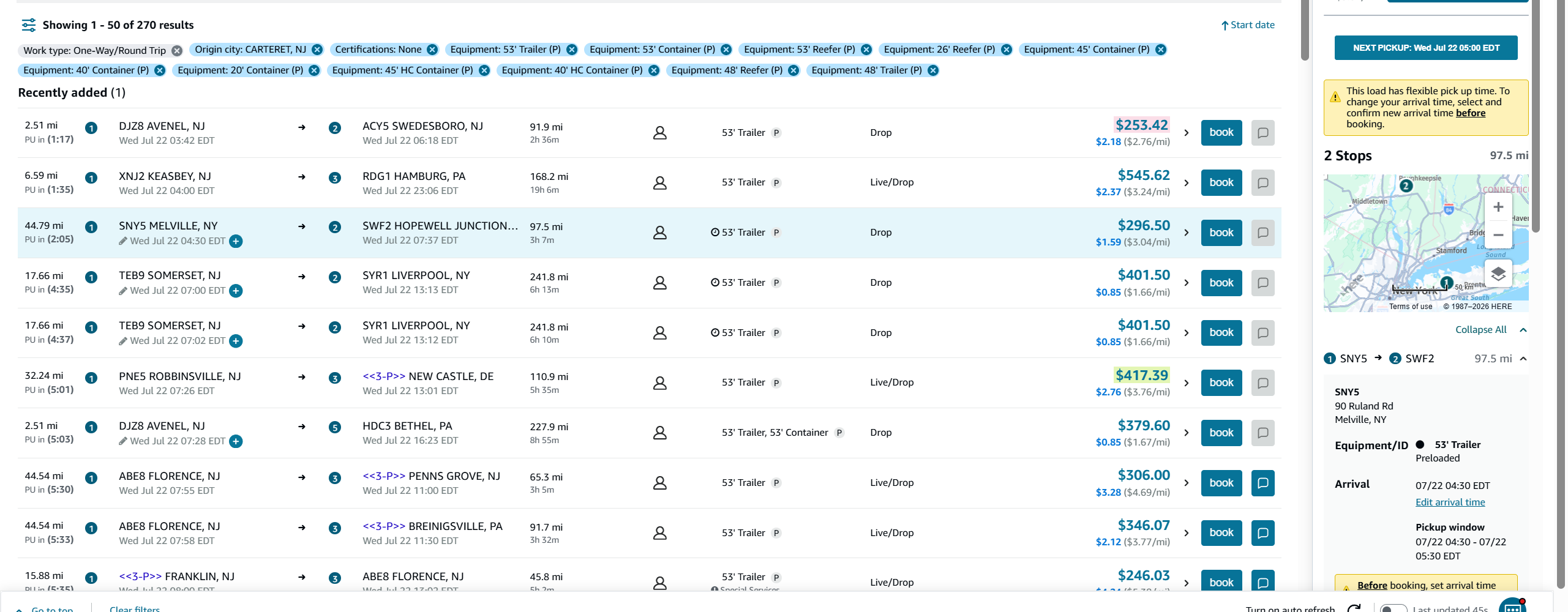
The row action and expanded-card action use the same Amazon pickup slots.
Amazing Relay filters are applied after Amazon returns the current list of loads. They do not reduce the number of loads Amazon sends to the browser.
What do the basic payout, mileage, deadhead, and stop filters do?
- Payout requires at least the entered total payout.
- Deadhead miles and Load miles set inclusive minimum and maximum ranges.
- Max stops One Way and Max stops Round Trip set separate inclusive limits. Do not show excludes that trip type.
Leave a field empty when you do not want that requirement to apply.
How is Minimum Base Rate calculated?
Minimum Base Rate checks base payout per loaded mile after fuel and toll surcharges are removed: (total payout − fuel surcharge − toll surcharge) ÷ loaded miles.
Example: A 100-mile load pays $1,000, including $40 fuel and $300 toll reimbursement. Its base rate is (1000 − 40 − 300) ÷ 100 = $6.60 per mile.
How do Coefficient and Deadhead coefficient work?
Coefficient estimates base payout per working hour. Amazing Relay estimates time as (30 minutes × stop count + load miles + adjusted deadhead) ÷ 60, then divides base payout by those estimated hours. It is a comparison tool, not a promise of actual hourly revenue.
Deadhead coefficient under Rate and Stops controls how much deadhead is added to that time estimate. It does not decide whether you can reach pickup; the separate Pickup Deadhead setting owns that check.
How does Decrease max load miles work?
After the selected computer-local start time, this control reduces Amazing Relay’s Load miles MAX by one mile per minute until it reaches zero. It works only when Load miles MAX has a value and does not change Amazon’s native Max miles filter.
How do States, locations, Exclude all stops, and presets work together?
Pickup fields apply to the first stop. Destination fields apply to the final stop. Include fields require a match; exclude fields reject a match. Exclude all stops also checks intermediate stops against the destination exclusion list.
State and location rules can conflict. For example, Destination state NY together with Destination state exclude NY requires and rejects the same final state. If a search returns no loads, review overlapping include, exclude, preset, state, and location values first.
Create reusable state or location groups in Extension icon → Options → Filter presets. State presets appear only in state fields and location presets only in location fields. Duplicates are ignored when presets and individual values are combined. Reload an open Load Board after editing presets.
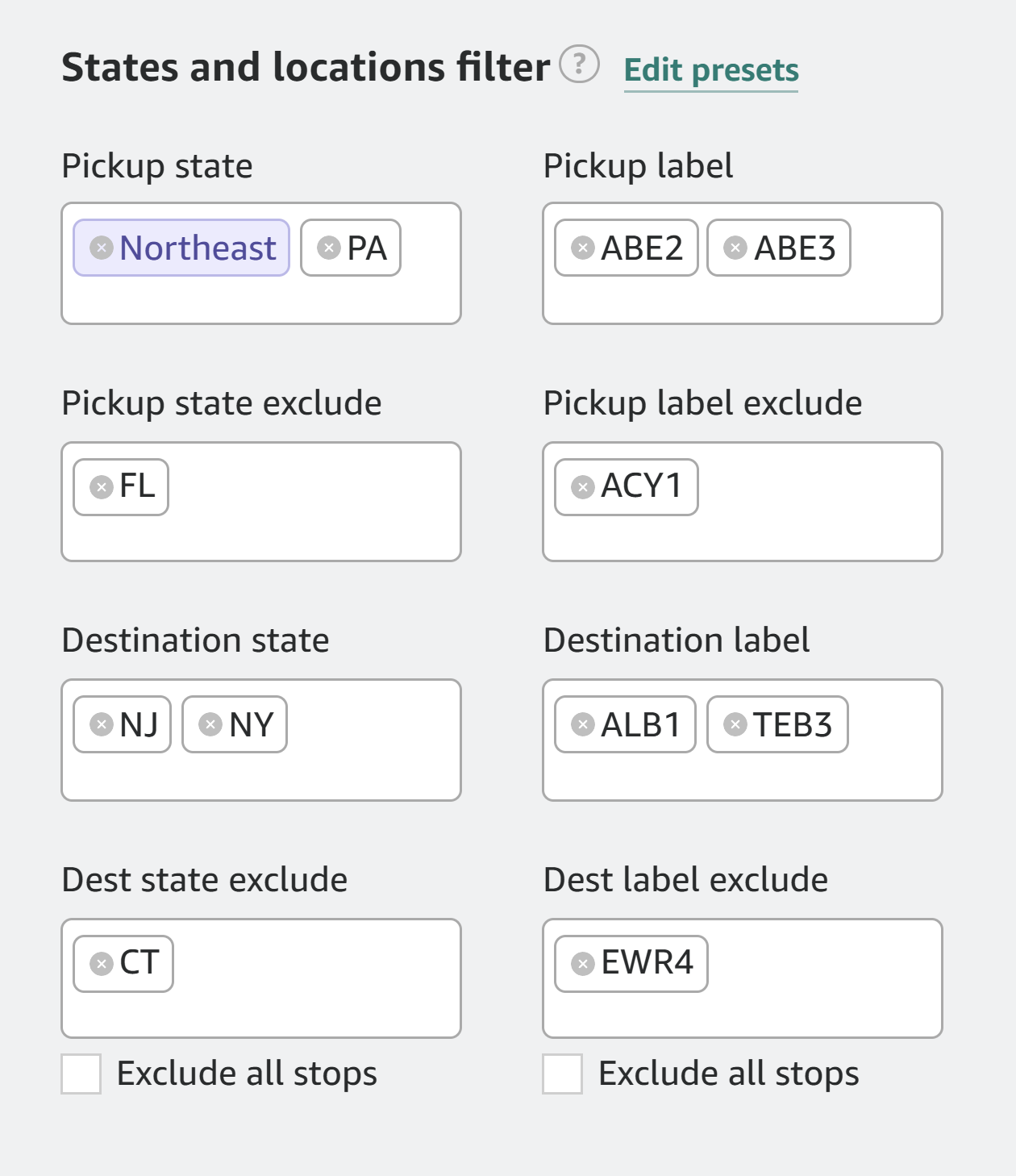
Check include and exclude combinations when a search becomes unexpectedly narrow.
What do the Load options control?
These filters handle load details that are easy to miss in the basic mileage and payout fields.
What does No stops over 3 hours exclude?
It rejects a load when a physical intermediate stop is longer than three hours. The final destination is not counted.
What is the difference between <<3-P>> display and Amazon locations only?
Amazing Relay marks recognized third-party locations with <<3-P>>. The Options setting Replace 3rd party location names changes how those names are displayed. The Load option Amazon locations only rejects a load when a stop is classified as third-party. Displaying a marker does not reject a load by itself.
What do No Railroads and No recovery <<ITR>> loads exclude?
No Railroads rejects loads Amazing Relay identifies as requiring a railroad terminal. No recovery <<ITR>> loads rejects recovery loads marked <<ITR>>. Recovery locations are handled separately from third-party <<3-P>> locations.
What does Empty trailers only include?
It keeps supported one-way trips that Amazing Relay identifies as an empty trailer or container movement.
How does Ignore TI miles affect mileage filters?
When enabled, Load miles MIN/MAX does not reject a load Amazing Relay identifies as empty/TI. Other filters still apply.
How should I choose a refresh speed across one or more tabs?
The selected speed is a target maximum for one tab, not a guaranteed rate. The current selector offers targets up to 2.50 requests per second.
This tab shows the measured Amazing Relay search rate in the current tab. All tabs shows the combined rate of active Amazing Relay searches in the current Chrome profile. Keep the combined rate at or below the displayed recommended limit of 2.70 requests per second.
Actual speed can be lower because of internet latency, Amazon Relay response time, the number and complexity of returned loads, and processing time. A lower value does not mean the selector is broken.
Manual Amazon refreshes and the final refresh after STOP are not included in these Amazing Relay search counters.
Alerts operate while an Amazing Relay search is running. The status area at the top of the Load Board records found, missed, booked, price, Demand Chat, settings, protection, and error messages.
How does Alarm behave in Monitoring and Autobook?
PLAY ONCE plays one sound when a matching load is found. REPEAT EVERY 5 SEC continues until you press STOP ALARM or start a new search. Monitoring can use either choice; Autobook uses the repeating alarm.
What does Price monitoring alert me about?
Price monitoring watches a visible load for a qualifying payout increase while START continues. The default threshold is 5%; you can choose a different threshold in its menu. Notification sound ON adds a short sound, while Notification sound OFF records the notification silently.
A price alert does not stop the search or make the load an Autobook candidate. The load must still pass the normal filters.
What does Demand Chat monitoring do?
Demand Chat monitoring alerts you when chat becomes available for a load during START. Choose Notification sound ON or OFF. Chat availability does not stop the search and does not make the load an Autobook candidate.
Where do I see my trial or subscription status?
Open the Amazing Relay extension menu, choose Options, and open Settings. The Subscription section shows the current company, access status, price or plan information, billing email when available, and the relevant Start or Manage action.
A new eligible company receives a 10-day trial. If access is expired or inactive, use the subscription action shown there. If the status is blocked or temporarily unavailable, follow the message in Options or contact support rather than repeatedly reinstalling the extension.
How does Time zone affect pickup filters?
The selected time zone controls how Amazing Relay interprets Pickup date MIN and MAX. Eastern, Central, Mountain, Pacific, and Arizona choices account for their supported seasonal clock behavior. The Pickup duration is relative and moves with the current time in Classic and Smart modes.
What do the Amazon Relay page settings change?
- Enable Fastbook buttons adds the manual one-click Fastbook interaction.
- Disable native similar and promoted loads hides Amazon’s native suggestions.
- Remove native information pop-ups on page load dismisses Amazon informational pop-ups.
- Remove Search and Post A Truck tabs on page load removes those native tabs.
- Remove ZIP codes keeps location names while hiding ZIP-code suffixes.
What does Replace 3rd party location names change?
It replaces recognized third-party names in displayed loads with <<3-P>>. This is a display setting. To reject third-party stops, use Amazon locations only in Load options.
Options save automatically. Reload an already-open Amazon Relay Load Board after changing Settings or Filter presets so the page receives the new values.
Why are no loads matching?
- Confirm the current Amazon saved search is broad enough and already returns relevant loads.
- Review payout, rate, distance, stops, pickup timing, and especially overlapping State/location include and exclude rules.
- Reload the Load Board if Settings or Filter presets were edited in Options.
- Open a returned load and check the Amazing Relay explanation below Estimated Payout to see which requirement it missed.
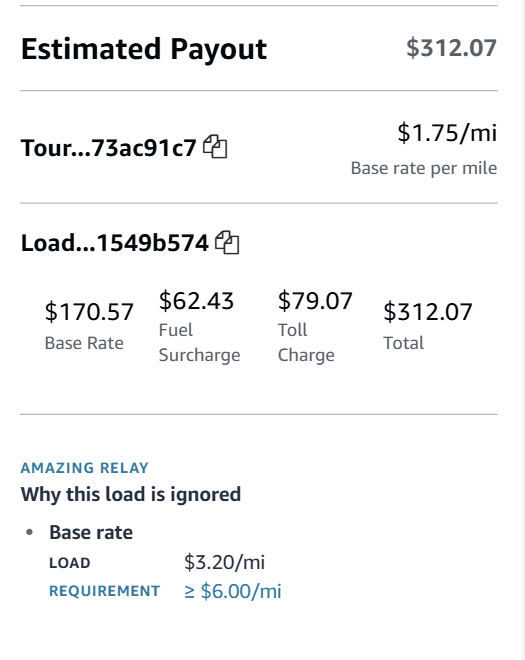
The Amazing Relay section names the load value and the requirement it missed.
Why did Amazing Relay stop searching?
Changing the Amazon saved-search tab or active search request during START safely stops Amazing Relay so it cannot continue against the wrong query. Repeated request failures, an expired Amazon session, or throttling can also stop a search. Review the status message, reload the page when requested, reopen the intended saved search, and then start again.
What should I do if Amazon throttles requests?
Stop Amazing Relay in every active tab and wait at least 30 minutes before starting again. Do not compensate by repeatedly reloading or opening additional search tabs.
Where can I get help?
Use the Telegram support link at the bottom of the Amazing Relay filter panel. Include the exact status message and a screenshot that shows the relevant controls, but do not send passwords, payment details, or private activation information.